
From ads-dependent to a second channel that pays for itself
A Pan-India legal consultation platform came to us wanting leads. Thirteen months later they had a scaled paid channel and an organic one built from zero.

- Client
- AidByLaw
- Engagement
- April 2025 – May 202613-month retainer
- Sector
- Legal and business consultation
- Services
- Website Revamp, SEO, Content Writing, Paid Ads (Google & Meta)
- Location
- Faridabad, serving Pan-India and NRIs
growth in paid leads
from the learning-phase months
organic leads a month
a channel that did not exist
Every page
redesigned and re-optimised
metas and copy rewritten for search
leads a month at close
across both channels
Leads, month by month
20 leads a month at the start. 390 at the close.
Shown exactly as it happened, including the two flat months while the ad platforms learned the account and the dip mid-engagement before further optimisation. Growth that only ever goes up is not what running live campaigns looks like.
The client
AidByLaw is a Pan-India legal and business consultation platform based in Faridabad, offering services across real estate documentation, business incorporation and compliance, individual legal matters such as name change, wills and marriage registration, and a dedicated track for NRIs managing Indian legal processes remotely. As a consultation-first business, its growth depends entirely on converting online visibility into calls, WhatsApp enquiries and form submissions.
The challenge
When AidByLaw approached us they had a generic template website with no meaningful SEO and no paid presence. Their immediate need was leads, but they were clear-eyed about wanting more than a short-term fix: a paid channel that could generate volume quickly, and an organic channel built alongside it, so the business would not stay permanently dependent on ad spend to keep enquiries coming in.
The build
- 01
Paid ads first
Month 1 onward
- 02
Website revamp and SEO
From month 2
- 03
Rebuilt around search
Months 2–5
The website
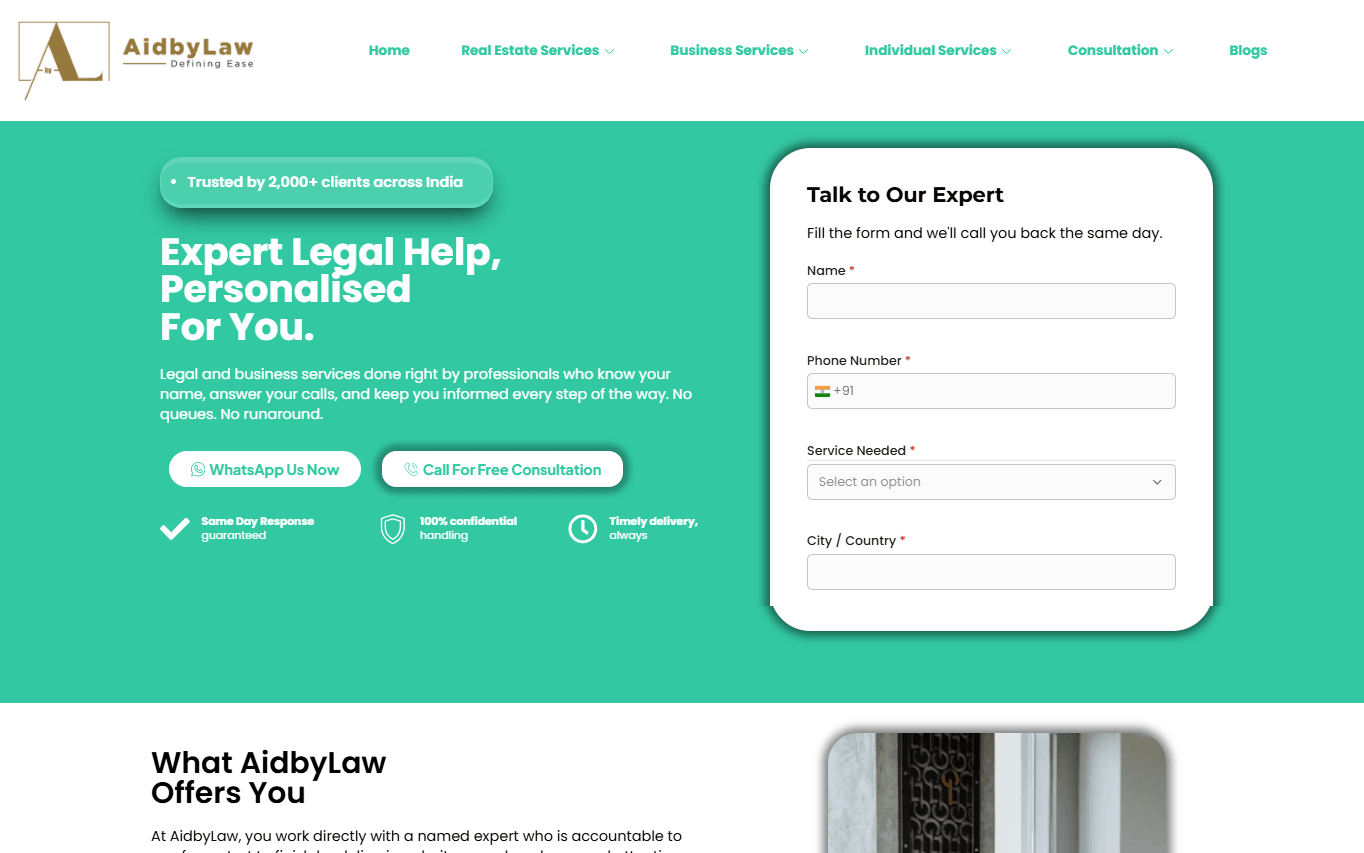
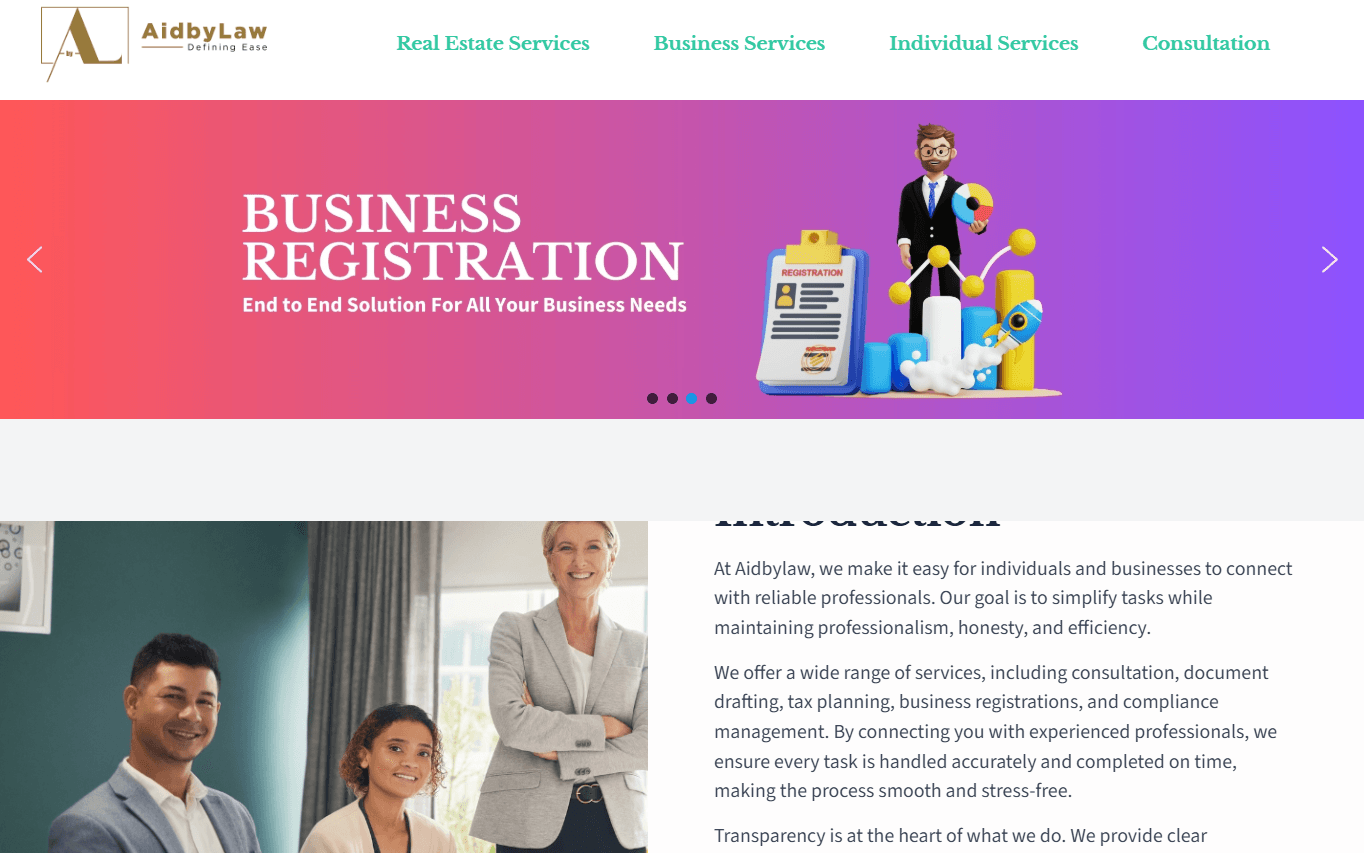
| Before | After | |
|---|---|---|
| Design | Generic clip-art template | Custom, photography-led design |
| Meta titles & descriptions | Generic and duplicated | Written per page around real search queries |
| On-page content | Written for the business | Rewritten around what buyers actually search |
| Navigation | 4 flat links, no sub-navigation | Grouped dropdowns by service area |
| Homepage lead capture | None, banner CTAs only | Embedded form above the fold |
| Trust signals | None | Client volume, guarantees, verified reviews |
| NRI audience | Not addressed | Dedicated section and enquiry form |
| Testimonials | Stock avatars | Verified Google reviews |
The results
Paid campaigns
The first two months were rougher than the rest. Both Google and Meta needed time to learn the business and its audience, and campaigns saw intermittent pausing and inconsistent delivery through that learning phase, holding leads to 20 to 30 a month. Once the algorithms stabilised, delivery smoothed and leads climbed steadily: 60, then 150, then 200, then 300 a month as the campaigns matured. Volume then settled back to around 270 a month for a stretch mid-engagement before further optimisation, recovering to a sustained 300 to 350 through the later months and into the close of the retainer. That is roughly a tenfold increase on the early learning-phase numbers, and both the slow start and the mid-course dip reflect the hands-on management a live ad account actually needs rather than a one-time win.
Organic search
Organic leads began appearing around month 5, starting at 20 a month and growing to 40 a month by the end of the engagement. This was a channel that did not exist at all beforehand, now contributing meaningfully without any ad spend behind it.
Both channels together
By the close of the 13-month engagement, AidByLaw was generating roughly 340 to 390 leads a month across both channels, up from 20 to 30 a month in the early learning-phase period, with a genuine second channel in place that had not previously existed.
In summary
AidByLaw came in dependent on the idea of ads for lead volume. Thirteen months later they had both a scaled paid channel and a genuinely new organic one built from zero, on top of a website whose every page had been redesigned, re-titled and rewritten around what buyers actually search, with the trust infrastructure it never had. Durable volume from ads, compounding growth from search: that combination was the sequencing we set out to deliver at the start.
These figures describe this engagement only. They are reported from the campaign and analytics reporting for this account, and they are not a prediction or promise of comparable results. What any business achieves depends on its market, offer, pricing and competition, and no agency controls the search and advertising platforms these results run on.
Want this sequencing for your business?
Start with the free scan, and see where you actually stand.